Why food security is becoming a question of stability, not supply
The grain we learned to trust
For thousands of years, wheat has been more than food. It has been reassurance across continents and cultures. It became the grain people trusted to be there, year after year, anchoring daily diets and social order alike. Wheat shaped settlement patterns, trade routes, and political decisions long before it filled supermarket shelves. Bread prices were never just about hunger, but about calm, continuity, and control. When wheat was plentiful and affordable, societies tended to hold together. When it was not, they rarely did.
That long history of reliability has shaped modern assumptions in ways few people consciously recognise. Governments plan food subsidies around wheat. Humanitarian aid relies on it as a dependable calorie source. Global markets assume that if one region falters, another will quietly fill the gap. Families across the world build daily meals around wheat without ever questioning whether it might not always be there.
What climate change is doing is not shattering wheat production overnight but steadily unpicking that trust. The danger lies precisely in how gradual the shift appears. Fields still turn green and harvests still mature. Yet beneath that surface continuity, the conditions wheat evolved to depend on are becoming less frequent, less reliable, and more fragile. This is not a crisis of total collapse, but of growing instability in a system that was built on the expectation of predictability.
The Intergovernmental Panel on Climate Change has repeatedly warned that rising temperatures, heat extremes, and changing rainfall patterns are already affecting crop productivity across major breadbasket regions, with wheat among the most exposed staples (IPCC AR6 Working Group II). Wheat was never designed to cope with constant uncertainty. It flourished in a world where seasons behaved in broadly recognisable ways, where extremes were the exception rather than the norm, and where farmers could rely on accumulated experience to guide decisions. That world is fading, and wheat is beginning to show us what that loss really means.
A crop with narrow margins for error
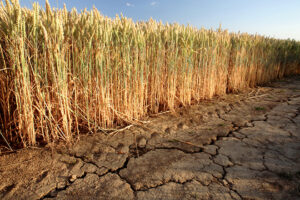
Wheat’s global reach creates the impression of resilience, yet physiologically it operates within narrow margins, particularly at key moments in its growth cycle. One of the most critical comes during flowering, when temperature, timing, and moisture must align with remarkable precision. Short periods of heat, sometimes lasting only a few days above roughly 30 to 32°C, can disrupt pollen viability and prevent grain from forming properly. To the naked eye, the crop often appears unharmed, standing green and upright in the field, even as yield potential quietly disappears.
This vulnerability has been well documented in agronomic and climate research. The Food and Agriculture Organization has shown that heat stress during flowering and grain filling stages leads to disproportionate yield losses, even when overall rainfall appears sufficient (FAO, Climate Change and Food Security). What makes climate change particularly dangerous for wheat is not simply warmer conditions, but the increasing frequency of poorly timed extremes that strike during these sensitive windows.
Failure, in this context, rarely announces itself through dramatic devastation. It emerges late, often at harvest, when there is nothing left to correct or recover. Farmers invest months of labour, water, and capital before discovering that conditions beyond their control have already determined the outcome.
The deeper consequence is the erosion of confidence. Knowledge passed down through generations, once rooted in reasonably stable patterns, is becoming less reliable. Planting calendars no longer align cleanly with weather behaviour. Risk becomes harder to anticipate and increasingly difficult to insure, because historical data no longer offers a dependable guide to future conditions. The OECD has highlighted how climate volatility is undermining traditional agricultural risk management and insurance models precisely because the past no longer predicts the future (OECD Agricultural Risk Management).
At a global level, this instability matters because wheat production has long relied on the assumption that variability would remain local. A poor season in one region could be offset by stronger performance elsewhere. Climate change is now undermining that logic by increasing the likelihood of simultaneous stress across multiple major wheat belts, shrinking the system’s ability to absorb shocks without cascading consequences.
When instability spreads beyond the field
Wheat’s importance extends far beyond agriculture because it sits at the intersection of food security, economics, and politics. For billions of people, wheat provides a significant share of daily calories, and for the poorest households it often accounts for a disproportionate share of food spending. Even modest price increases can therefore have outsized effects, forcing families to cut back on quantity, quality, or both.
History shows that sharp food price spikes rarely remain confined to the kitchen. Research by the International Food Policy Research Institute has linked sudden increases in staple food prices to social unrest, including during the 2007–2008 global food price crisis and the period leading up to the Arab Spring (IFPRI Food Price Crises). Wheat matters in these moments because it is not easily substituted, particularly in regions where diets, subsidies, and political legitimacy are tied to bread affordability.
As climate volatility increases, wheat markets are becoming more reactive and less forgiving. When multiple producing regions experience stress at the same time, governments often respond defensively by introducing export restrictions or stockpiling to protect domestic supply. While understandable at a national level, these actions amplify instability globally, driving prices higher and faster than physical shortages alone would justify. The World Bank has repeatedly warned that such policy responses can turn climate shocks into broader food security crises (World Bank Food Security Update).
The result is a food system that transmits shock rather than absorbing it. What begins as climatic stress in the field becomes economic pressure in markets, political anxiety in capitals, and real hardship in households already living close to the edge. This chain reaction is not hypothetical. It is already unfolding, often without being explicitly framed as a climate driven food security issue.
Adding to this challenge is a quieter, less visible shift in nutritional quality. Elevated atmospheric carbon dioxide reduces protein, zinc, and iron concentrations in wheat grain, meaning that even where calorie supply holds, nutritional value declines. This effect has been demonstrated in multiple studies, including research published in Nature Climate Change, with significant implications for populations that rely on wheat as a primary source of nourishment (Nature Climate Change, CO₂ and Nutrition).
Food security, in this context, cannot be measured solely by tonnes harvested. It increasingly depends on reliability, affordability, and nutritional adequacy in a climate that is undermining all three simultaneously.
The limits of adaptation and the question of stability
There is no shortage of effort aimed at adapting wheat to a changing climate. Plant breeders are developing heat tolerant varieties. Farmers are adjusting practices. Digital tools promise improved forecasting and risk management. These advances matter, and they will shape how wheat production evolves.
What they cannot do, at least not quickly enough, is restore the underlying stability the global food system was built upon. Breeding resilient crops takes decades. Water resources are becoming more constrained across many key wheat growing regions. Increased reliance on chemical inputs may support short term yields but often deepens long term vulnerability rather than resolving it.
The uncomfortable truth is that adaptation is being asked to compensate for a loss of climatic stability it was never designed to replace. The global food system, with wheat at its core, was optimised for efficiency under relatively stable environmental conditions. Climate change is removing that stability faster than adaptation can realistically keep pace.
This forces a more difficult conversation about what food security really means in an era of persistent volatility. Producing more is no longer sufficient if production cannot be relied upon. Efficiency loses its value when it comes at the expense of resilience. Markets struggle when uncertainty becomes the norm rather than the exception.
Wheat exposes this challenge with clarity because so much depends on it, yet the lesson extends far beyond a single crop. The deeper question is whether societies are prepared to acknowledge that modern food systems were built for a climate that no longer exists, and that safeguarding food security may now require fundamentally different choices about risk, resilience, and governance.
Wheat was built for a world that behaved itself. the climate no longer does. Recognising that gap is not pessimism it is the starting point for a more honest, and ultimately more durable, approach to feeding the world.
Conclusion: food security in a world without guarantees
The story of wheat is often told as a technical challenge, framed in terms of yields, genetics, and agronomy, yet at its core it is a profoundly human story about trust and the quiet agreements societies make with the natural world. For centuries, wheat allowed people to believe that tomorrow would look broadly like yesterday, that seasons would arrive on time, and that effort would be rewarded with sustenance. That belief underpinned not just farming, but the political and economic systems built upon it.
Climate change is breaking that belief more thoroughly than many are prepared to admit. Not through dramatic collapse, but through the steady erosion of reliability. When wheat becomes unpredictable, food security shifts from a question of production to a question of stability, and stability is far harder to manufacture than abundance. Markets can respond to shortages, but they struggle with uncertainty. Governments can subsidise prices, but they cannot legislate away volatility. Farmers can adapt practices, but they cannot control the timing of heat, rain, or extremes.
What makes this moment uncomfortable is that it forces a reckoning with assumptions that have long gone unchallenged. The global food system was designed for efficiency in a relatively stable climate, and wheat sat comfortably at its centre because it rewarded that design. As the climate becomes more erratic, that efficiency begins to look less like progress and more like exposure. The buffers that once absorbed shock are thinning, while the risks are becoming increasingly synchronised across regions and borders.
Food security in the coming decades will not be secured by optimism or incremental adjustment alone. It will depend on whether societies are willing to prioritise resilience over short term gain, redundancy over just in time efficiency, and long-term stability over immediate yield. It will require acknowledging that some risks cannot be engineered away, and that safeguarding staple crops like wheat is as much a question of governance, equity, and foresight as it is of science.
Wheat was built for a climate that behaved itself, and for generations it rewarded that bargain with reliability. The climate no longer behaves as it once did. Recognising that reality is not a counsel of despair, but an invitation to rethink what food security must mean in a warming world. The choices made now will determine whether wheat remains a foundation of stability or becomes a symbol of a system that failed to adapt in time.