Disease, delayed harvests and the warning signs from the latest season
A season that no longer resolves itself
For most of modern agricultural history, the orange harvest arrived not as a surprise but as a culmination, the natural closing of a growing season that farmers understood intuitively because the trees themselves followed a pattern shaped by decades of climatic stability. Flowering, fruit set, ripening and harvest moved in sequence, allowing growers to plan labour, irrigation, contracts and markets with a degree of confidence that made citrus viable as a long-term crop. That confidence is now dissolving.
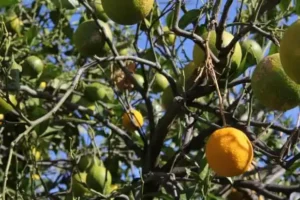
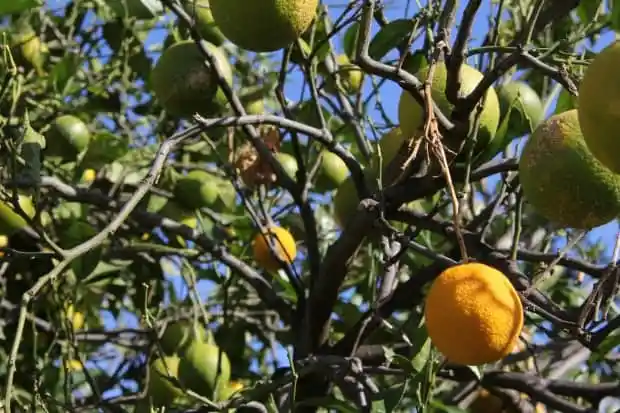
Across major citrus regions, from southern Europe to Brazil and Florida, harvests are sliding later into the year, often into November, not because growers are choosing to extend the season, but because the fruit is struggling to complete its development under prolonged heat stress, erratic rainfall and disrupted recovery periods. Colour break is delayed, sugar accumulation lags, fruit size becomes inconsistent, and oranges remain on trees longer than planned, exposed to further stress and disease pressure while growers wait for maturity that no longer arrives on time.
This shift is not subtle. In Spain, one of Europe’s largest citrus producers, recent seasons have seen harvest delays of several weeks, accompanied by yield losses estimated at 10–20 percent in some regions following heatwaves and drought episodes. Similar patterns are emerging across the Mediterranean basin, where climate volatility is increasingly cited as a driver of declining citrus reliability rather than isolated seasonal anomalies.
Globally, the Food and Agriculture Organization has warned that climate variability is now one of the most significant risks to perennial crops, with citrus singled out as particularly vulnerable due to its sensitivity to prolonged heat, water stress and disease interactions. What makes the latest harvests so alarming is not simply that they are late, but that lateness is becoming normalised, eroding the seasonal rhythm on which citrus production depends and replacing predictability with permanent uncertainty.
Disease accelerating where climate erodes resilience
When climate stress becomes chronic rather than episodic, trees enter a state of physiological exhaustion, diverting energy away from defence mechanisms and towards survival, a shift that leaves them dangerously exposed to disease at precisely the moment when environmental conditions favour its spread.
Citrus greening disease, or Huanglongbing, has become the most devastating expression of this vulnerability, transforming once-productive orchards into liabilities and reshaping entire citrus economies. In Florida, where the disease has intersected brutally with rising temperatures and extreme weather, orange production has collapsed by more than 70 percent since the early 2000s, falling from over 240 million boxes at its peak to under 70 million boxes in recent seasons.
While citrus greening is caused by a bacterium spread by the Asian citrus psyllid, climate change has amplified its impact at every stage, with warmer winters increasing vector survival, heat-stressed trees showing reduced tolerance, and recovery periods shrinking or disappearing altogether. The United States Department of Agriculture has explicitly acknowledged that climate conditions are intensifying disease pressure and undermining long-term control strategies.
Beyond greening, fungal diseases such as citrus black spot and Alternaria brown spot are becoming more prevalent as heavy rainfall events increase humidity during critical stages of fruit development, leading to higher rejection rates for fresh markets and forcing more fruit into lower-value processing streams. While total volumes may appear superficially stable in some years, usable yield declines, profitability erodes and growers are left absorbing higher costs for fungicides, labour and crop losses.
The latest harvests reveal how climate stress and disease no longer act independently and reinforce one another in a feedback loop that steadily weakens orchards and shortens their productive lifespan.
Decline hidden behind supply and price signals
One of the most misleading narratives surrounding climate impacts on food is the idea that supply disruptions are temporary and self-correcting, yet oranges increasingly demonstrate how decline can hide behind continued availability, even as the underlying system frays.
Brazil, the world’s largest orange producer and exporter of orange juice, has experienced repeated production shocks linked to drought and extreme heat, with the 2023–24 season seeing yield reductions of around 10–15 percent in key growing regions, alongside smaller fruit size and lower juice content. Industry data from CitrusBR highlights climate stress as a growing structural risk to both volumes and quality.
These pressures translate directly into price signals. Global orange juice prices reached record highs in 2024, with futures prices increasing by more than 80 percent year-on-year at their peak, driven by reduced supply from Brazil and Florida combined with rising production costs and disease losses. Consumers see this as inflation, growers experience it as volatility layered on top of uncertainty.
At farm level, the picture is starker. Repeated poor seasons push smaller producers out, accelerate consolidation and discourage replanting, especially when young trees take years to reach productivity and face the same hostile climate upon maturity. Orchards are removed and not replaced, quietly shrinking productive capacity while the market continues to function just enough to mask the long-term damage. What looks like adaptation is often attrition, with the system shedding resilience crop by crop, season by season.
A perennial crop nearing its adaptive limits
Oranges are resilient within the climatic envelope they were bred for, capable of withstanding heat, drought and disease when those pressures remain intermittent and recoverable, however, resilience has limits, and the latest harvests suggest those limits are being tested repeatedly and simultaneously.
Physiological thresholds are being crossed more often, with extreme heat disrupting flowering, prolonged drought impairing root systems, and sudden rainfall events undermining water management strategies. Breeding programmes are racing to develop disease-resistant and heat-tolerant rootstocks, yet breeding operates on timescales measured in decades, while climate change is reshaping growing conditions within a handful of seasons.
Adaptation measures such as irrigation expansion, shade structures and altered planting densities can reduce stress temporarily, but they require water, energy and capital at a time when those resources are increasingly constrained, particularly in regions already facing water scarcity. Unlike annual crops, citrus trees cannot relocate quickly, meaning orchards are effectively stranded as climate zones shift around them. This immobility transforms climate change from a challenge into a structural threat, one that optimisation alone cannot resolve.
Conclusion: a warning written into the harvest
The orange harvest is no longer simply about fruit reaching maturity, but about a system under visible strain, expressed through delayed seasons, spreading disease, declining volumes and rising prices that ripple through global food chains. The latest harvests are not anomalies, nor are they temporary setbacks waiting to be corrected by the next good year.
Oranges are under pressure now, in orchards that are producing less, costing more and carrying greater risk with every passing season. The warning is not hidden in abstract climate models, but hanging on trees into November, struggling to complete a season that no longer fits the world they are growing in.
Food security depends not only on production, but on reliability, and reliability is what climate change is steadily stripping away. The orange harvest is telling us this clearly, if we are willing to listen.